Context mise en place
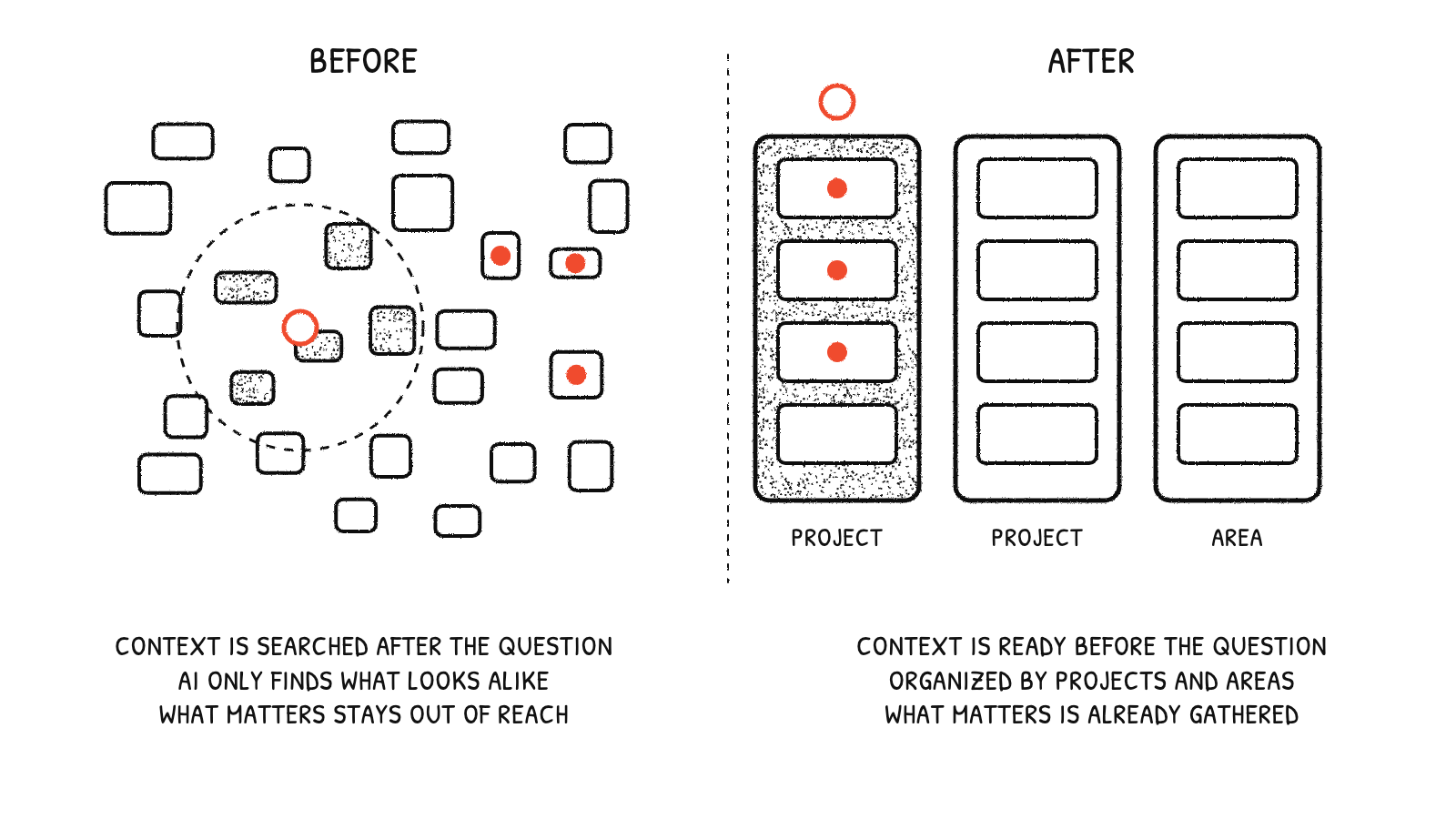
Today, AI looks for its context when you talk to it, and it doesn’t know what it doesn’t know. That context should be prepared beforehand, around your projects and areas of responsibility, and given to the model before your prompt.
 Eliott Meunier
In this article, I introduce a concept: context mise en place.
I explain why an AI that looks for its own context is on the wrong track, why most context systems fail today, and what to build instead.
The idea fits in one sentence: the AI shouldn't have to look for context at the moment you ask. Context should be prepared ahead of time, continuously, around your projects and your areas of responsibility, then given to the model before it even reads your prompt.
Does this sound familiar?
- You ask AI to help with a project, and you spend the first ten minutes re-explaining where things stand.
- It finds one document, misses three others, and answers as if it had read everything.
- It remembers a detail you mentioned four months ago, and ignores the decision you made yesterday.
- When you ask it for ideas, it gives you back the ones you already had.
- The more you hand over to it, the less you know what it actually knows.
These problems look different. They have a single cause: the AI looks for its context at the moment you talk to it, and it doesn't know what it doesn't know.
To understand why, you have to look at how an AI finds its context today.
How AI finds its context
In 2022, a language model could only look inward. It answered with what it had learned during training, and nothing else.
Then models learned to use tools. They were given web search, access to your files, your email, a database. That's when people started talking about agents.
In 2025, it became clear that the quality of an answer depends mostly on what the model has in front of it when it answers. This was called context engineering.1
The dominant response was to let the agent search on its own: load context just in time, when it needs it, rather than in advance.2
In practice, when you ask a question, the agent decides what to look for. It has four ways to do it.
| Method | What it finds | What it misses |
|---|---|---|
| Keywords | Documents that contain the words you typed | Everything that says the same thing in other words |
| Folders | What's filed where the agent thinks to look | What's filed somewhere else |
| Embeddings | What resembles the question | What's useful without resembling it |
| Knowledge graph | The neighbors of the starting point | What isn't connected to anything known |
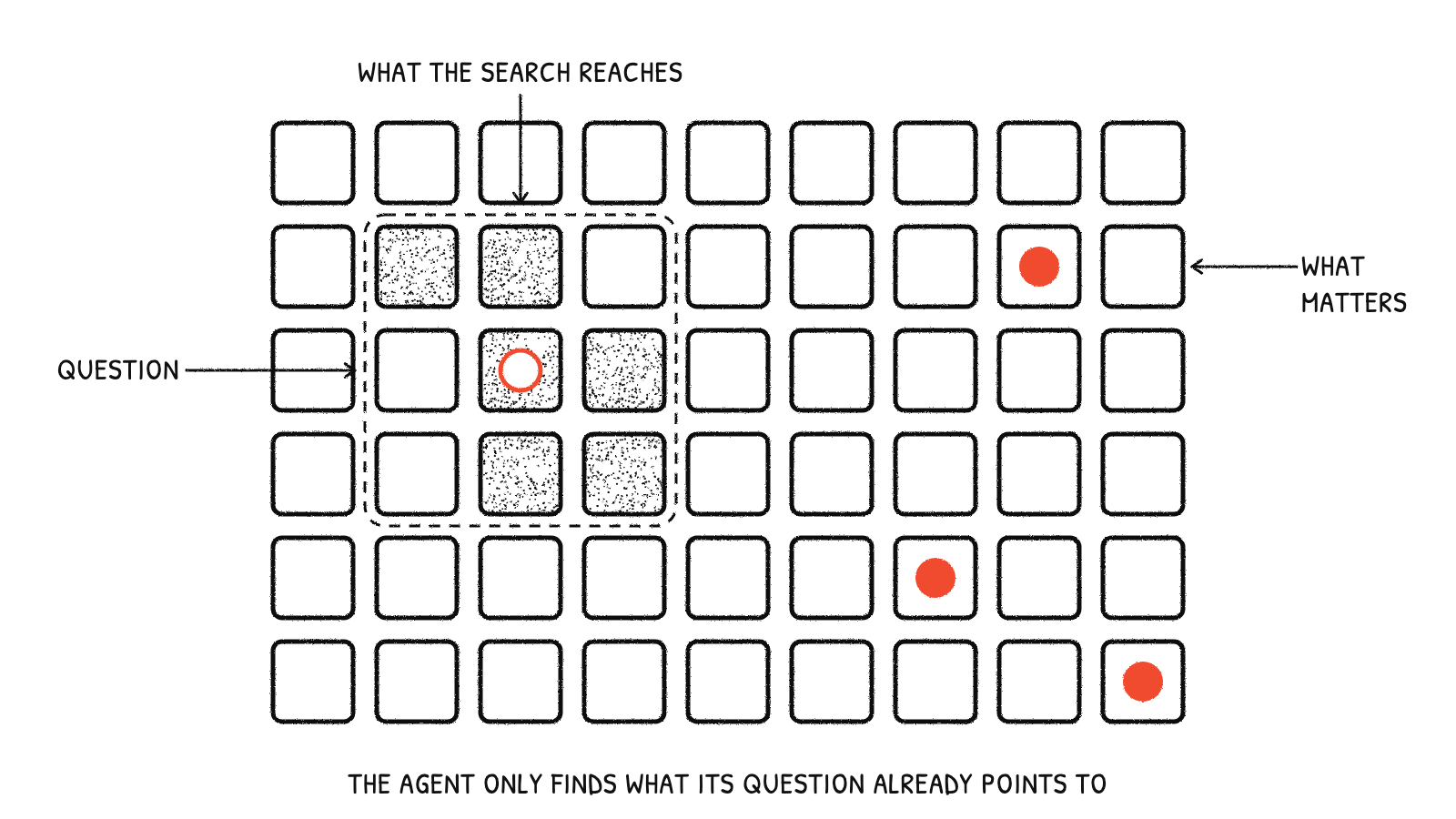
All four have one thing in common: they start from the question.
The agent only finds what its question already points to.
AI doesn't know what it doesn't know
To search well, you need to know what you're looking for. To know what you're looking for, you need to know what you're missing.
That's where everything breaks.
People sometimes call this the Dunning-Kruger effect. The precise term is meta-ignorance: not knowing that you don't know.3
A human who searches often senses that something is missing, even without being able to name it.4 An agent doesn't. Its discovery starts from zero.
This has three effects.
It stops too early. A few fragments are enough for it to believe it's informed.5
It searches with the wrong words. Two people use the same word for the same thing less than one time in five.6 And what embeddings can retrieve has mathematical limits.7
It fills the gaps. When its context isn't enough, it doesn't say “I don't know.” Models are trained in a system where a plausible answer earns more than admitting uncertainty. So they guess.8
You know the result: a fluent answer, built on a few fragments, with the gaps filled in by the average.
What matters doesn't resemble the question
There's a second problem, and it's worse.
If I ask my AI to help me write an article about ecology, it will look for my notes on ecology.
My most interesting ideas on the subject probably aren't there. They're in something I read about fermentation, in a call with a client who was telling me about his logistics, in a reflection I wrote after a dance workshop. None of them contains the word “ecology.”
And ideas almost always come from bringing two distant things together.9
In the 1980s, two bodies of medical literature ignored each other: one on fish oil, the other on Raynaud's syndrome. Connecting them produced a treatment hypothesis, confirmed three years later.10 No search starting from one led to the other.
Similarity search does the opposite. It brings back what's similar, reinforces the obvious, and pushes away the distant. Models even end up converging on the same answers, from one conversation to the next and from one model to another.11
If you cross the two problems, you get four cases.
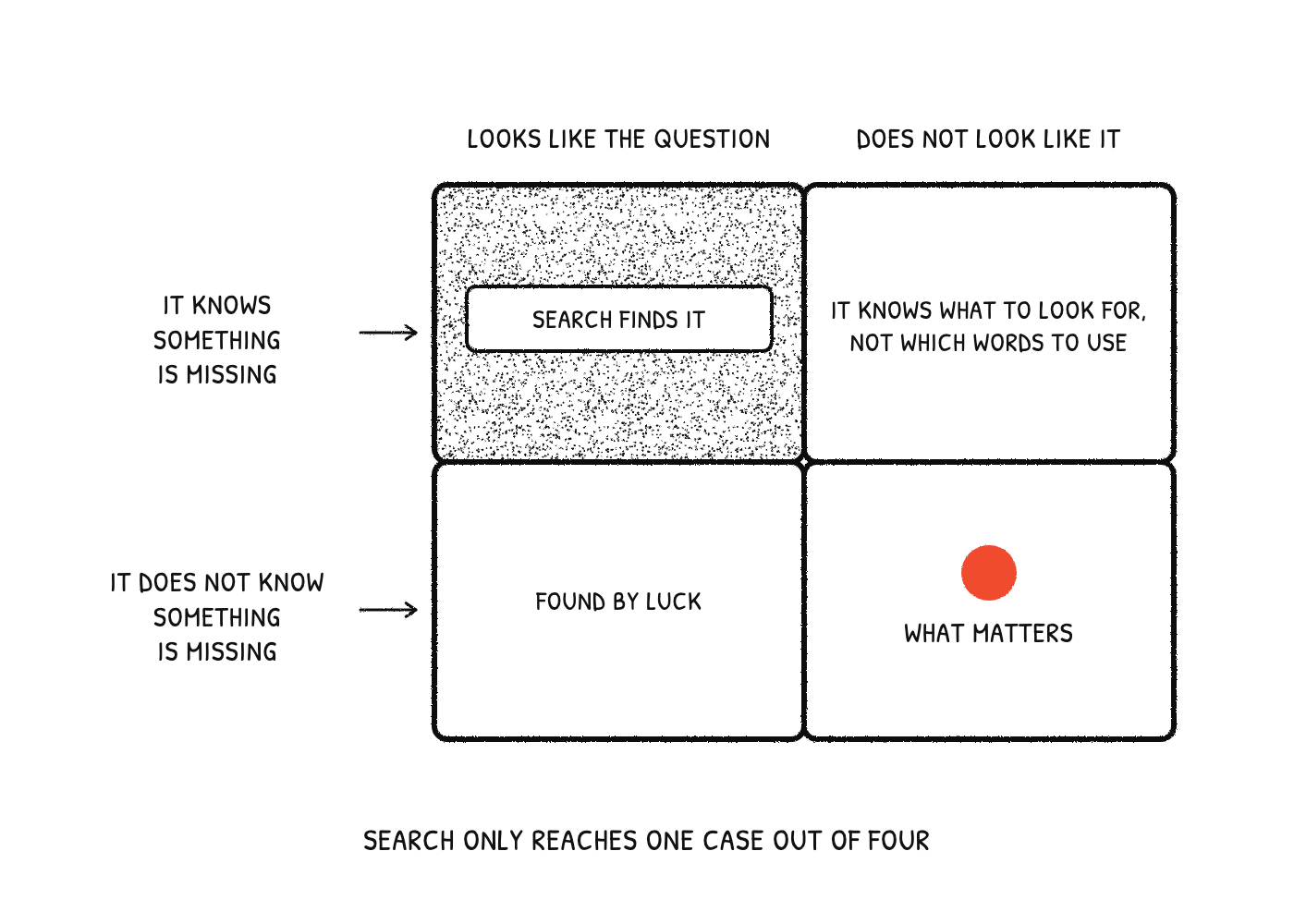
Search reaches only one case out of four: when the agent knows what it's missing, and what it's missing resembles its question.
The opposite case, distant information the agent doesn't know exists, is where the ideas that matter are. No query gets in there.
Prepare before, instead of searching after
The solution isn't to search better. It's to prepare ahead of time.
With context mise en place, the AI no longer looks for its foundation when you ask. That foundation is prepared continuously, then given to the model before it reads your prompt.
The AI can still search to fill in details: a number, a specific document, a fact. But it searches from a complete context, not from nothing.
| Searched context | Context mise en place | |
|---|---|---|
| When | After the question | Before, continuously |
| Who chooses what to read | The agent, with what it already knows | The system, with everything you live through |
| What comes up | What resembles the question | What matters for the project |
| The gaps | Filled in by the AI | Visible |
| For whom | For the machine | For you first |
This changes three things.
Quality. A model that has worked on a context before the question answers better, with far less compute at answer time.12 A prepared context gives more accurate answers for a fraction of the tokens.13
Cost. A stable context, sent again with every exchange, costs about ten times less than a fresh one, thanks to model caching.14 You pay for the preparation once.
Logic. If the model doesn't realize it needs a piece of context, it will never ask for it.15 Only context given in advance solves that problem. The best coding agents already do this: they load a context file first, and only search afterward.2
One question remains. You can't prepare everything. You need a principle to decide what to prepare, and how to organize it.
Organize context the way you organize your life
That principle has existed for more than forty years.
In the early 1980s, David Allen was coaching overwhelmed executives.16 What he saw: the mind is made for having ideas, not for storing them.
Every vague commitment, every “I should,” stays open in your head and uses up attention. Allen calls these open loops.
You don't need to finish a loop to be free of it. It's enough for a trusted system to hold it, with a clear next action.17
His method, Getting Things Done, comes down to five steps: capture, clarify, organize, reflect, engage. The system holds the context, so the human can think.18
Allen organizes this context into horizons.
| Horizon | What it is |
|---|---|
| Purpose | Why I do all this |
| Vision | Where I want to be in three to five years |
| Goals | Where I want to be in one to two years |
| Areas of responsibility | What I maintain, with no end date |
| Projects | An outcome to achieve, which has an end |
| Actions | What I do today |
These horizons describe how people think and talk. When you talk about your work or your life, you almost always speak from a current project, a responsibility, or a big question you carry.
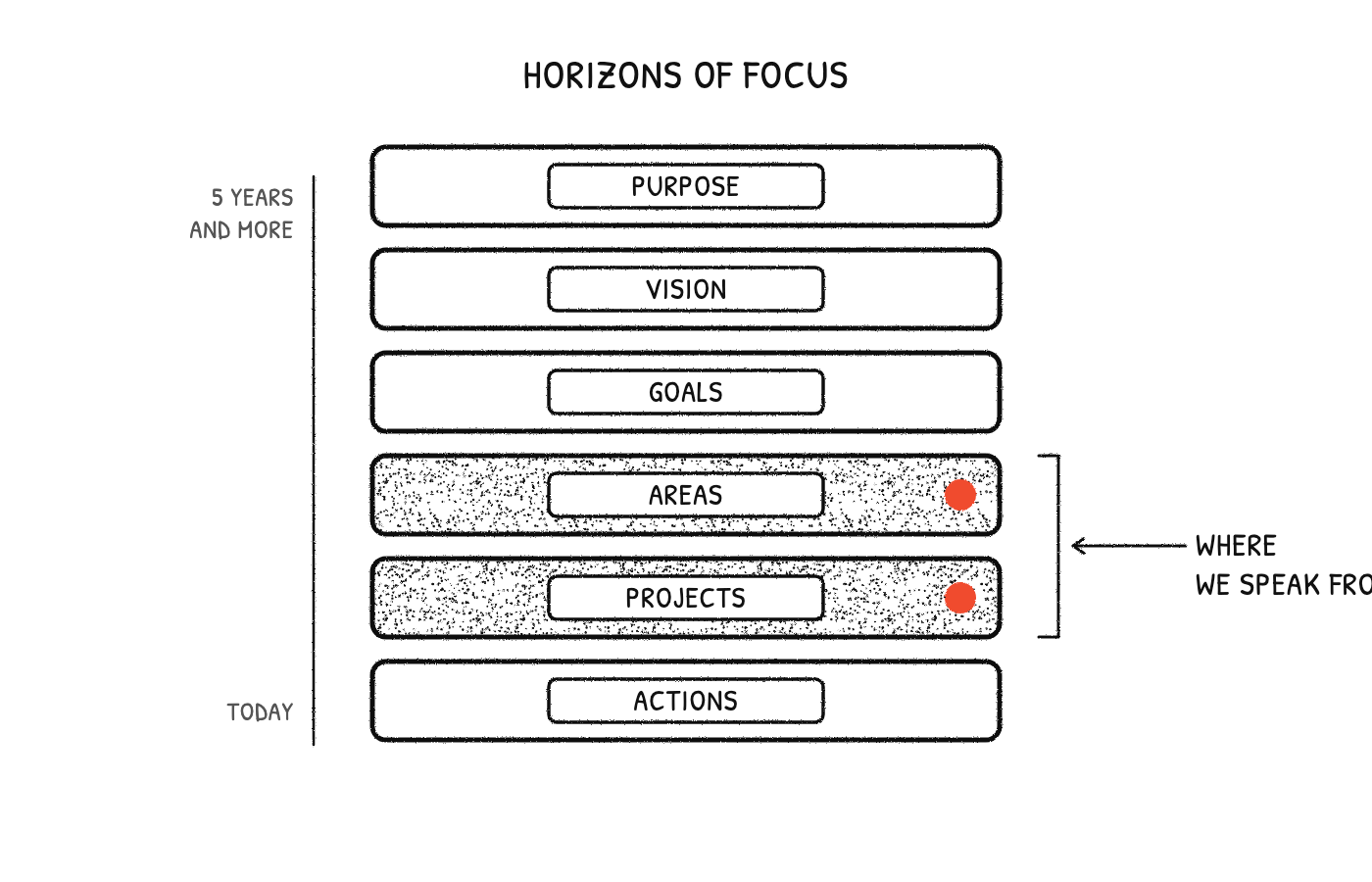
Tiago Forte turned this into a simple filing rule: organize by usefulness, not by topic.19 In the system I teach, IPCRA, this becomes a question: in what context would I want to come across this information again?
A project has an end. An area doesn't: it's a role you hold.
That's the right principle for organizing an AI's context. Not topics. Not entities. Projects and areas, because that's where you'll be talking to it from.
How it works
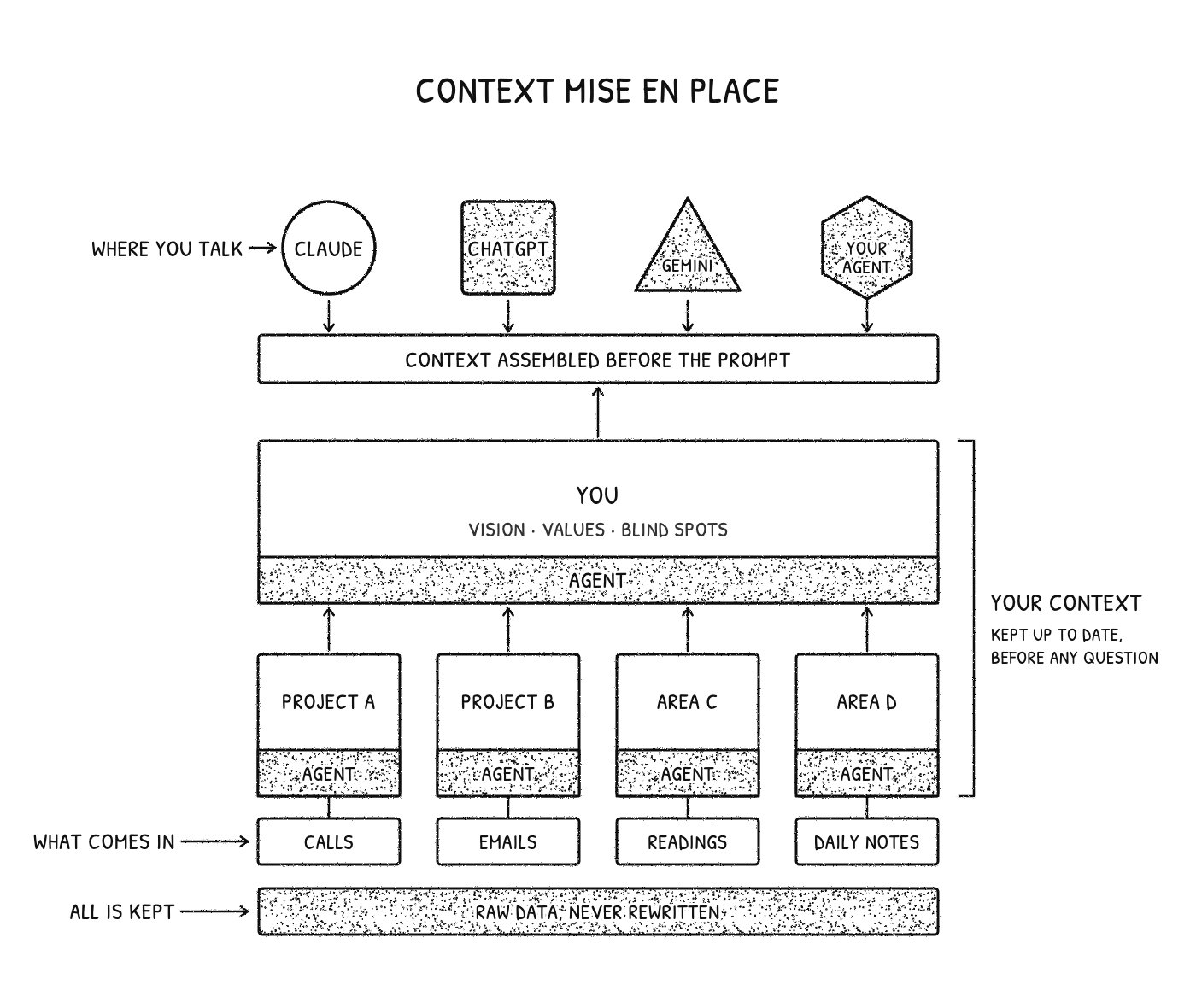
Context mise en place does four things.
- Capture everything that comes in: calls, emails, reading, the day's notes.
- Attach each item, as soon as it arrives, to a project, an area, or the person's vision.
- Update each project's context, looking forward: what's true now, the decisions made, the open loops, the next action.
- Connect everything in a knowledge graph, built on top of the raw data, which is never rewritten.
The graph works when no one is asking a question. That's when it can bring distant items together: fermentation and ecology, fish oil and Raynaud's.
Then, when you talk to your AI about a project, the context assembles before your prompt, from the most stable to the most recent: who you are and where you're going, the relevant area, the project, what just happened.
What Allen asked people to do by hand (clarify, organize, do a weekly review) is exactly what makes most people give up on the method. It takes discipline.
It's also exactly the work a machine can do continuously.
For the human, not the machine
Many people today are building memories for their AI: knowledge bases designed for an agent to consult.
That's approaching the problem backwards.
A memory the AI manages for itself drifts. One evening you tell it you'd like to be a rock star, and four months later it's still bringing it up. An organization designed for the machine becomes unreadable for the human. And context that no one reads anymore ends up being wrong.
Context mise en place has the human as its first reader. You read a project's context: what moved forward, what's stuck, the next action, what you promised and to whom. It's a permanent weekly review. The AI is just one more reader.
Because this context truly represents you, with your values, your ambitions, and your blind spots, the AI can do better than imitate you. It can help you grow.
An AI that resembles you too much amplifies your biases. An AI that knows you can show you what you don't see.
And why projects and areas? Because that's also where happiness is decided. People flourish through projects that are meaningful, manageable, and aligned with who they are.20 Of everything that makes a good day, nothing weighs as much as the sense of making progress in work that matters.21
The goal isn't to feed a machine. The goal is context that evolves with you, and helps you evolve.
What context mise en place is not
It's not injecting everything. The longer a context gets, the more models get lost in it.22 Mise en place serves a dense core, a few thousand words focused on the right project.
It's not freezing summaries. A summary rewritten a hundred times drifts. The raw data stays intact: you can always go back to the source.
It's not surveillance. Context this complete only makes sense if it belongs to the person: stored with them, encrypted, usable with any AI.
It's not sending notifications. Automatic summaries sent to users every morning have already been abandoned.23 Preparing the model's context has nothing to do with pinging the human. Useful proactivity stays within the scope of your projects and areas.
It's not banning search. The AI keeps searching. It just searches from what matters to you.
The time it takes to get ready to think
In 1960, a researcher who wanted humans and computers to think together measured his own days. About 85% of his “thinking” time went to getting into a position to think: searching, gathering, preparing.24
Today, we ask our AIs to go through that again with every question.
Context mise en place does that work ahead of time. So the moment you talk to the AI is the moment you think together.
That's what I'm building.
What I'm building
In concrete terms, context mise en place takes the form of software.
It's both your context software and your organization software. The two are one, because context is organized around what you do.
On the left, your projects and areas. Each one is a thread.
In each thread, you find the up-to-date context, prepared by the AI. Your next actions. The timeline of what happened. Your notes. Your conversations with the AI about that subject.
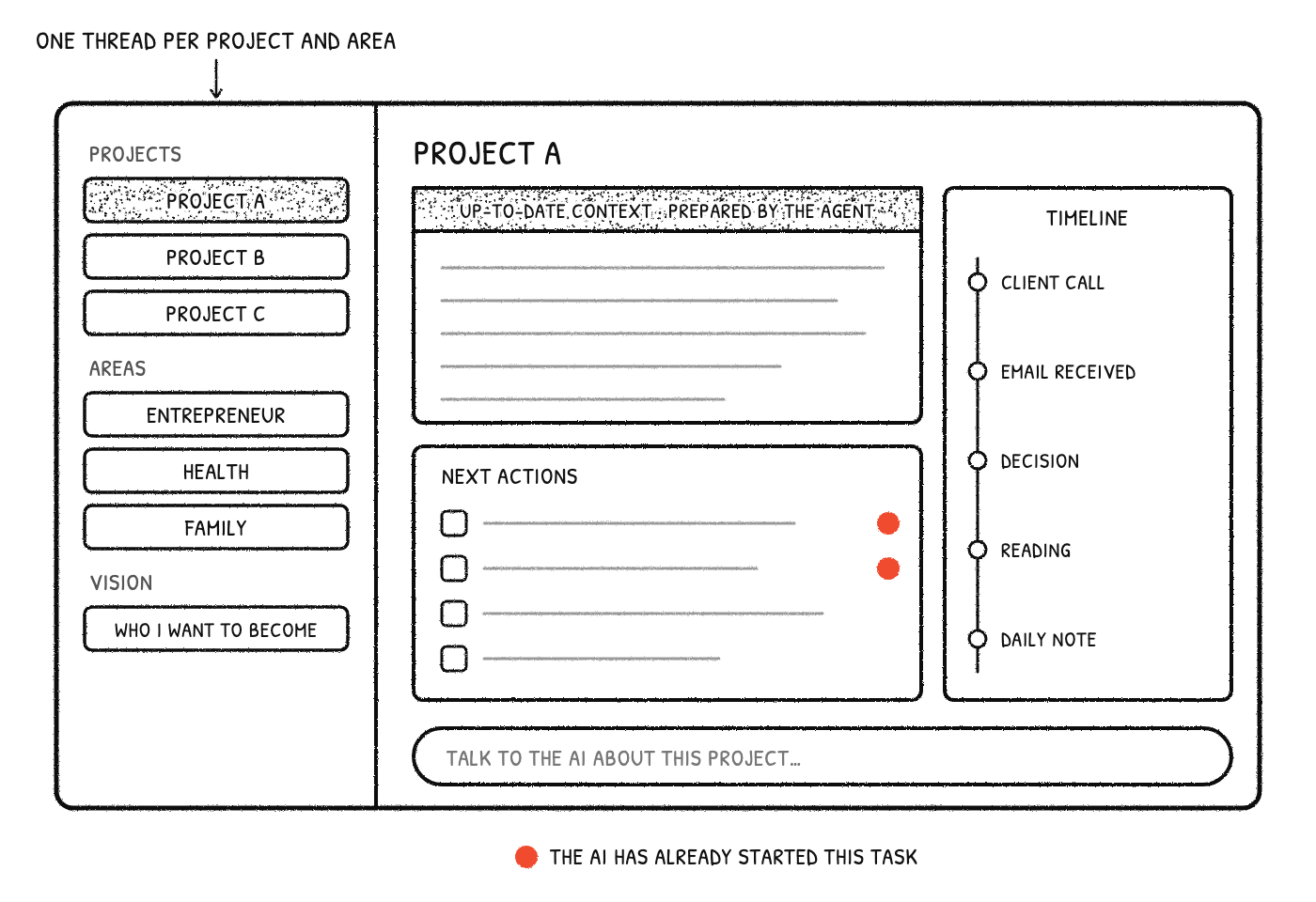
Behind each project and each area, an agent is waiting. It wakes up with every item that concerns it: a call, an email, something you read, a note. It updates the context, flags what changed, and suggests what comes next.
Your tasks are no longer just lines in a list. The AI enriches them (some research, a contact, a dependency) and starts making progress on them before you even get to them. You approve.
An agent above them looks at your whole week. It suggests what to do, always within the scope of your projects and areas.
Capture happens on its own: your calls, your emails, your reading, what gets said during your day. Transcription runs locally, and everything is encrypted.
The context belongs to you. It isn't tied to any model: it can feed Claude, ChatGPT, or whatever AI comes next.
And because it truly represents you, with your values, your ambitions, and your blind spots, the AI doesn't just answer you. It can coach you.
The result: when you open a conversation about a project, you don't re-explain anything. The AI knows where you stand, what's stuck, what you promised and to whom. You start straight with the thinking.
Part of this system already runs in my own second brain: capture, sorting the inbox by projects and areas, the weekly review. The next step is to make it continuous, and accessible to everyone.
Context engineering taught us that context matters. Context mise en place says where it should come from.
Notes
- The term took hold in June 2025, popularized by Tobi Lütke and then Andrej Karpathy. Simon Willison, “Context engineering”, June 27, 2025.
- Anthropic, “Effective context engineering for AI agents”, September 29, 2025. The post contrasts retrieval before inference with “just in time” context, and describes Claude Code as a hybrid: CLAUDE.md files loaded up front, search afterward.
- David Dunning, “The Dunning-Kruger Effect: On Being Ignorant of One's Own Ignorance”, Advances in Experimental Social Psychology 44, 2011. The Dunning-Kruger effect itself is disputed on statistical grounds: Gignac and Zajenkowski, Intelligence, 2020.
- Nicholas Belkin, “Anomalous States of Knowledge as a Basis for Information Retrieval”, Canadian Journal of Information Science 5, 1980. The problem goes back to Plato's Meno (80d-e): how do you search for something you don't know exists?
- Zhang et al., “To Search or Not to Search”, February 2026.
- Furnas, Landauer, Gomez and Dumais, “The Vocabulary Problem in Human-System Communication”, Communications of the ACM 30(11), 1987.
- Weller et al. (Google DeepMind), “On the Theoretical Limitations of Embedding-Based Retrieval”, ICLR 2026.
- Kalai et al. (OpenAI), “Why Language Models Hallucinate”, 2025; Joren et al. (Google), “Sufficient Context”, ICLR 2025.
- Sarnoff Mednick, “The Associative Basis of the Creative Process”, Psychological Review 69, 1962; Arthur Koestler, The Act of Creation, 1964.
- Don Swanson, “Fish Oil, Raynaud's Syndrome, and Undiscovered Public Knowledge”, Perspectives in Biology and Medicine 30(1), 1986; clinical confirmation: DiGiacomo et al., American Journal of Medicine, 1989.
- Jiang et al., “Artificial Hivemind”, NeurIPS 2025.
- Lin, Snell, Wang et al. (Letta, UC Berkeley), “Sleep-time Compute: Beyond Inference Scaling at Test-time”, April 2025: about five times less compute at query time, for the same accuracy.
- Rasmussen et al., “Zep: A Temporal Knowledge Graph Architecture for Agent Memory”, 2025; Joe McElroy (Elastic), “Cutting agent costs with pre-computed context”, May 2026.
- Prompt caching documentation from Anthropic, OpenAI and Google: cached reads are billed at around 10% of the normal price, sometimes less.
- Microsoft Agent Framework, “Adding Context Providers”, 2026.
- David Allen, Getting Things Done, 2001, revised edition 2015; the GTD horizons.
- Masicampo and Baumeister, “Consider It Done! Plan Making Can Eliminate the Cognitive Effects of Unfulfilled Goals”, Journal of Personality and Social Psychology 101(4), 2011.
- Heylighen and Vidal, “Getting Things Done: The Science behind Stress-Free Productivity”, Long Range Planning 41(6), 2008; Clark and Chalmers, “The Extended Mind”, Analysis 58(1), 1998.
- Tiago Forte, Building a Second Brain, 2022; the PARA method.
- McGregor and Little, “Personal Projects, Happiness, and Meaning”, Journal of Personality and Social Psychology 74(2), 1998; Sheldon and Elliot, “Goal Striving, Need Satisfaction, and Longitudinal Well-Being”, Journal of Personality and Social Psychology 76(3), 1999.
- Teresa Amabile and Steven Kramer, The Progress Principle, Harvard Business Review Press, 2011.
- Hong, Troynikov and Huber (Chroma), “Context Rot”, July 2025; Liu et al., “Lost in the Middle”, TACL, 2024.
- ChatGPT Pulse, launched September 25, 2025 and retired June 17, 2026 in favor of scheduled tasks.
- J. C. R. Licklider, “Man-Computer Symbiosis”, IRE Transactions on Human Factors in Electronics, 1960.